
본문
Unconventional domain tessellations
in moiré-of-moiré lattices

By prof. Changwon Park
Department of Physics
PURE Research Profile
cwparkphys@ewha.ac.kr
Rich Domain Tessellations patterns in Twisted Trilayer Graphene
Twisted bilayer graphene (TBG) revolutionized 2D materials research by showing that a small twist between layers can give rise to correlated electronic phases. In our recent Nature publication, we report that twisted trilayer graphene (TTG) exhibits an even richer set of structural and electronic phenomena. When two independent twist angles are introduced, the three graphene layers form two moiré patterns, whose interference produces a moiré-of-moiré superlattice with spatial periodicities reaching hundreds of nanometers.
Atomic reconstruction at ultralow twist angles
Using transmission electron microscopy (TEM), we directly visualize the reconstructed structures of TTG at extremely small twist angles (0.04-0.1°). At this regime, the system develops commensurate stacking domains separated by well-defined domain walls. Surprisingly, the shapes of these domains vary drastically depending on the twist-angle combination. These emergent patterns arise because TTG hosts two almost-degenerate stacking orders, Bernal (ABA/ACA) and rhombohedral (ABC/ACB), whose tiny energy difference becomes decisive at ultralow twist angles.
A complete structural phase diagram
By systematically varying the two twist angles, we construct the first full structural phase diagram of TTG. The transitions between triangular, kagome-like, and hexagram domain lattices occur abruptly when the balance between the competing stackings shifts. To explain these observations, we develop a large-scale interatomic potential capable of relaxing millions of atoms, revealing that long-range interactions across all three layers are essential. This distinguishes TTG fundamentally from TBG, where only nearest-layer interactions dominate.
Electronic implications: domain-selective states
The reconstructed domain networks strongly influence the electronic structure. Using electronic structure calculations on ~3 million atoms, we find that rhombohedral domains become gapped under a perpendicular electric field while Bernal domains remain metallic, forming conductive islands. Also, boundaries between ABC and ACB domains host topological-like channel states. These results suggest that TTG can serve as a programmable platform, where stacking geometry and twist angles jointly control electronic pathways, opening a route toward engineered correlated phases and domain-based quantum devices.
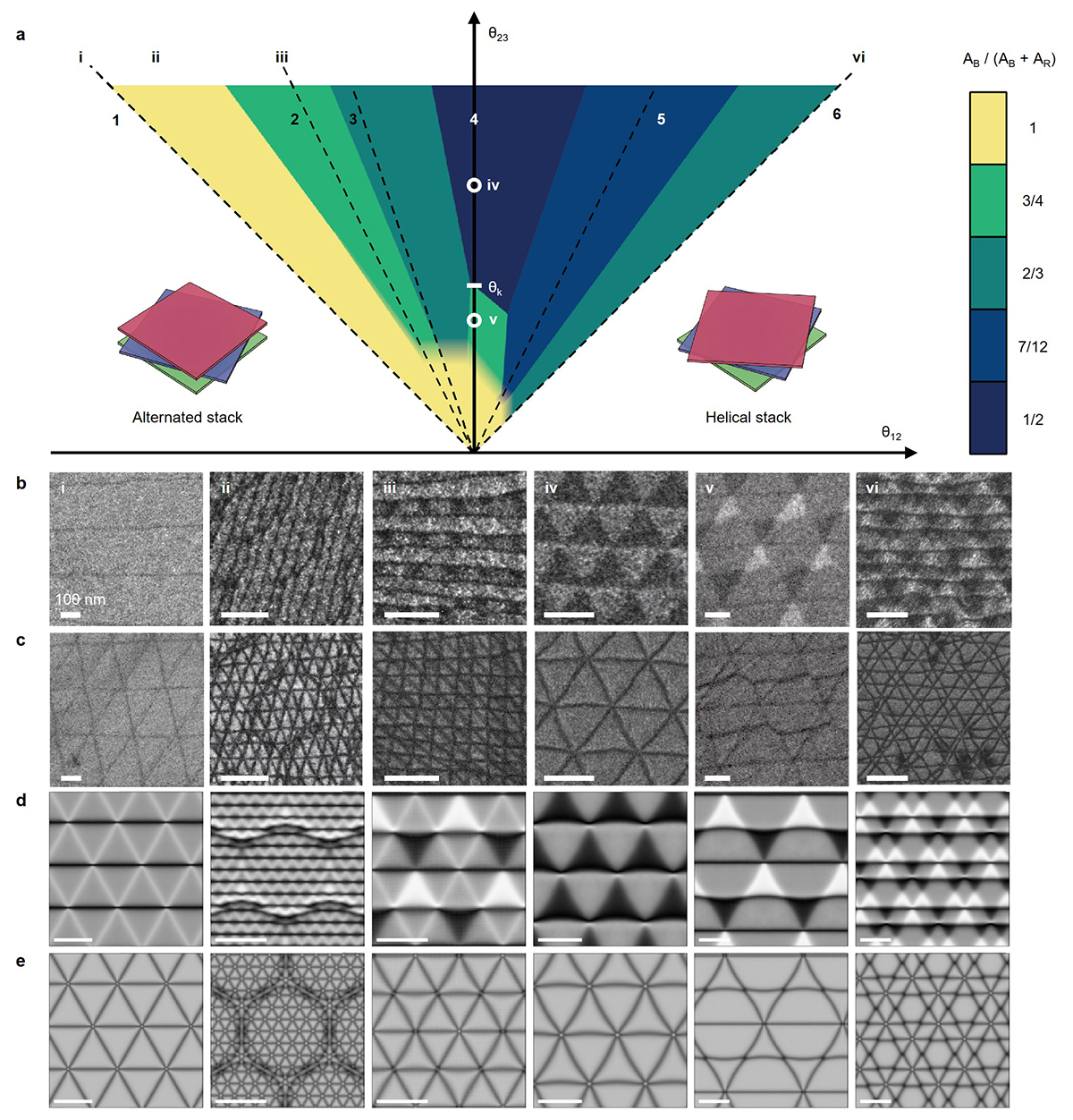
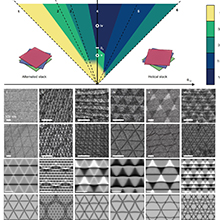
Figure. Full structural phase diagram of twisted trilayer graphene. The top panels show TEM observations, and the bottom panels present multi-million-atom simulation results.
* Related Article
Daesung Park, Changwon Park, Kunihiro Yananose, Eunjung Ko, Byunghyun Kim, Rebecca Engelke, Xi Zhang, Konstantin Davydov, Matthew Green, Hyun-Mi Kim, Sang Hwa Park, Jae Heon Lee, Seul-Gi Kim, Hyeongkeun Kim, Kenji Watanabe, Takashi Taniguchi, Sang Mo Yang, Ke Wang, Philip Kim, Young-Woo Son, Hyobin Yoo, Unconventional domain tessellations in moiré-of-moiré lattices, Nature, 641, 896-903, 2025.

